
Unfinished Adoration of the Magi
The image on the left compares the size of Botticelli's Adoration of the Magi with Leonardo's Adoration of the Magi. You can see how large Leonardo's Adoration of the Magi is. In terms of area, it is almost four times larger.
Botticelli's Adoration of the Magi was painted about three years before Leonardo began painting Adoration of the Magi. The Roman ruins-like building painted by Botticelli in the upper left corner of the painting clearly influenced Leonardo's work. The pose of the person on the right side of Leonardo's painting looking in is also likely influenced by this painting.
Regardless of whether Leonardo was competitive with Botticelli, there is no doubt that he used this painting of Adoration of the Magi as a reference.
|
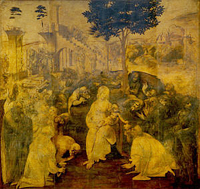
Adoration of the MagiOil on wood, 243 x 246 cm Florence, Galleria degli Uffizi, Inv. 1594
The Adoration of the Magi itself is not particularly unusual, being a popular theme that was widely accepted by church officials at the time, but Leonardo's Adoration of the Magi has characteristics that are very different from other works and stands out as unique. It seems that it would have been safe to create it if it had been made a little closer to his other works, but Leonardo's creative attitude of deliberately incorporating innovative compositions and interpretations into his works is unique, and this caused various problems with many of his clients later on. The Roman ruins in the background of this painting are not particularly unique, but the horse battle scene on the right side of it is a questionable depiction. It may be that he is trying to depict a scene from "Massacre of the Innocents," but it also seems that he simply wanted to depict a horse battle scene. The depiction of a large cloth-like curtain drawn underneath is also a mystery. It is completely unclear what this curtain is and what it is trying to do. Perhaps it is not a curtain or anything, but simply a painting of the background of the figures that is painted black and something is being painted on top of it with highlights, but in any case, it is a mysterious depiction. Furthermore, each person gathered around the figure is in some kind of pose, but it is completely unclear what they are trying to do or what they are implying. Thus, it cannot be denied that the components of this painting lack a clear meaning. It is possible that the church objected to this unusual composition of the work, and ultimately the church terminated the contract before the work was completed. As a result, the church, which had already made a certain amount of payment, took over the work in progress, and the plan to hand it over to a new painter did not go well, which may be the real reason why the Adoration of the Three Kings was left unfinished. As for the painting itself, Leonardo's depiction of the figures at this time is noticeably childish and awkward. For example, the depiction of the feet of the Virgin Mary in the center of the painting is one example. Although she is holding Jesus with her left leg raised, the toes of the left foot are drawn further back than the right foot, making it a completely inconsistent depiction. Furthermore, even the right foot, which is not that difficult, has a unclear knee position and does not establish a relationship with the upper body. There are countless examples, but Jesus' right leg is also incredibly long. The more you look at this painting, the more you notice its immaturity, but even so, this painting already shows a characteristic that only Leonardo could have drawn at this time. It is a large movement that spreads across the entire screen. The artist freely arranges moving figures on the canvas to create a larger movement as a whole. A painting in which each individual figure is accurately drawn and simply lined up on the canvas is like any other ordinary painting and is boring. In contrast, Leonardo's paintings, although they may not be accurate, have a unique charm that makes you stare at them without even realizing it. The Adoration of the Kings is one such painting, and no matter how crude the individual depictions may be, the overall appeal they create is special.
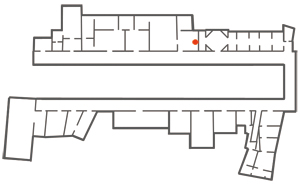
The Uffizi Gallery Museum
|

leonardoresearch.jp